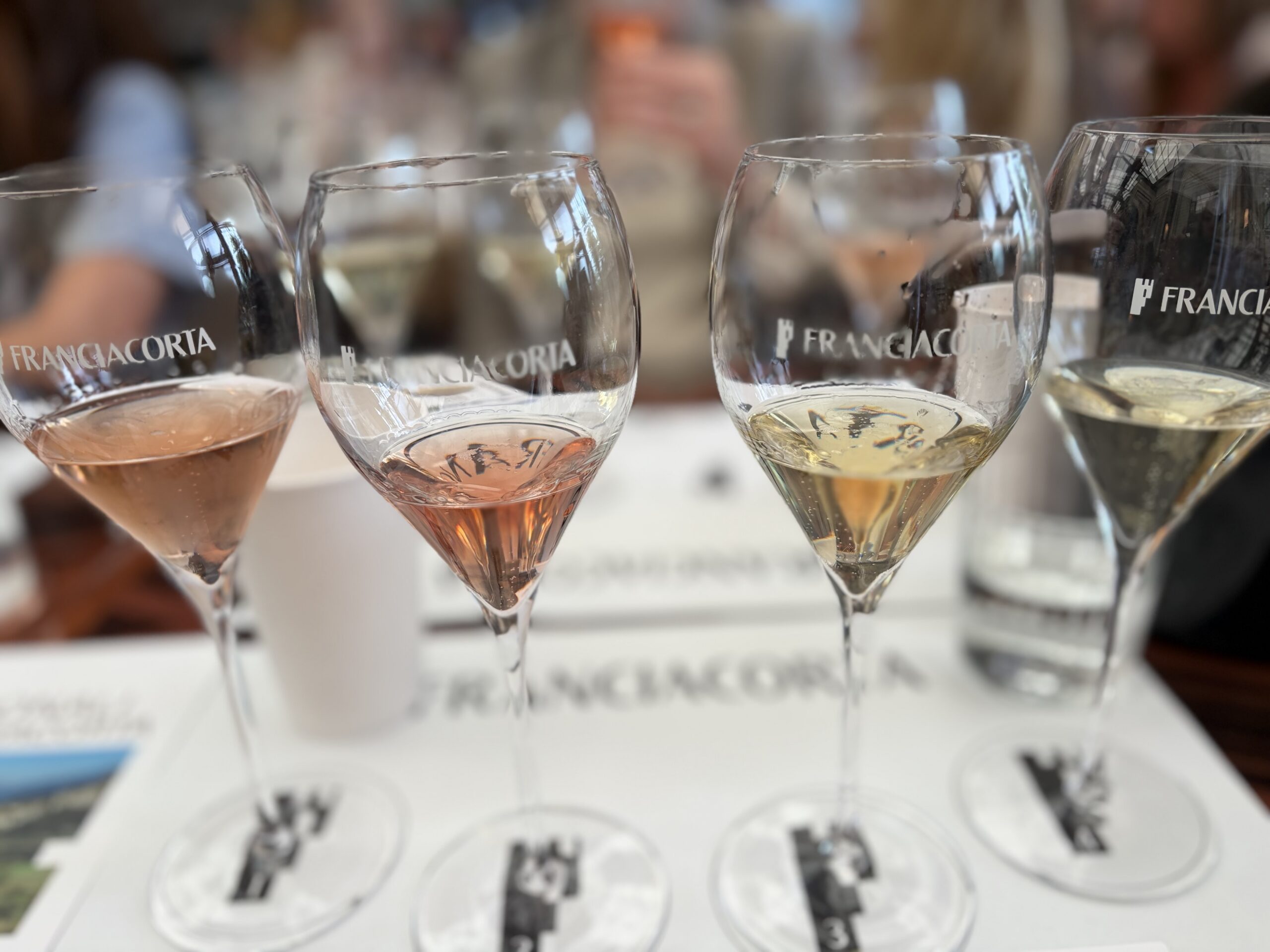
If you think all Italian fizz begins and ends with Prosecco, it’s time to expand your palate. Recently, I had the pleasure of diving deep into Franciacorta during an incredible tasting at Catch in West Hollywood. Far from a mass-market sipper, Franciacorta is a meticulously crafted, niche category of sparkling wine that proudly holds its own against the best bubbles in the world. Apparently actors agree, since Franciacorta bottles were found gracing every single table at the Emmys!
What is Franciacorta?
History & Origins
The name Franciacorta has a fascinating linguistic origin, stemming from the medieval francae curtes, referring to the “free courts” established by Cluniac monks who were exempt from local taxes. The Cluniac monks (members of the Order of Cluny) flourished primarily from the 10th century through the 12th century (with the abbey itself being founded in 910 AD and the order lasting until its suppression in the late 18th century). Winemaking history in the region evolved rapidly:
-
1961: The first modern Franciacorta was produced.
-
1967: Achieved official DOC status.
- 1990: 29 producers came together to create the Consortium (today there are 200 producers involved)
-
1995: Upgraded to prestigious DOCG status, with the first official DOCG bottle hitting the market in 1997.
-
2017: The rare indigenous grape Erbamat was officially approved for blending to help combat climate shifts.
Terroir & Geography
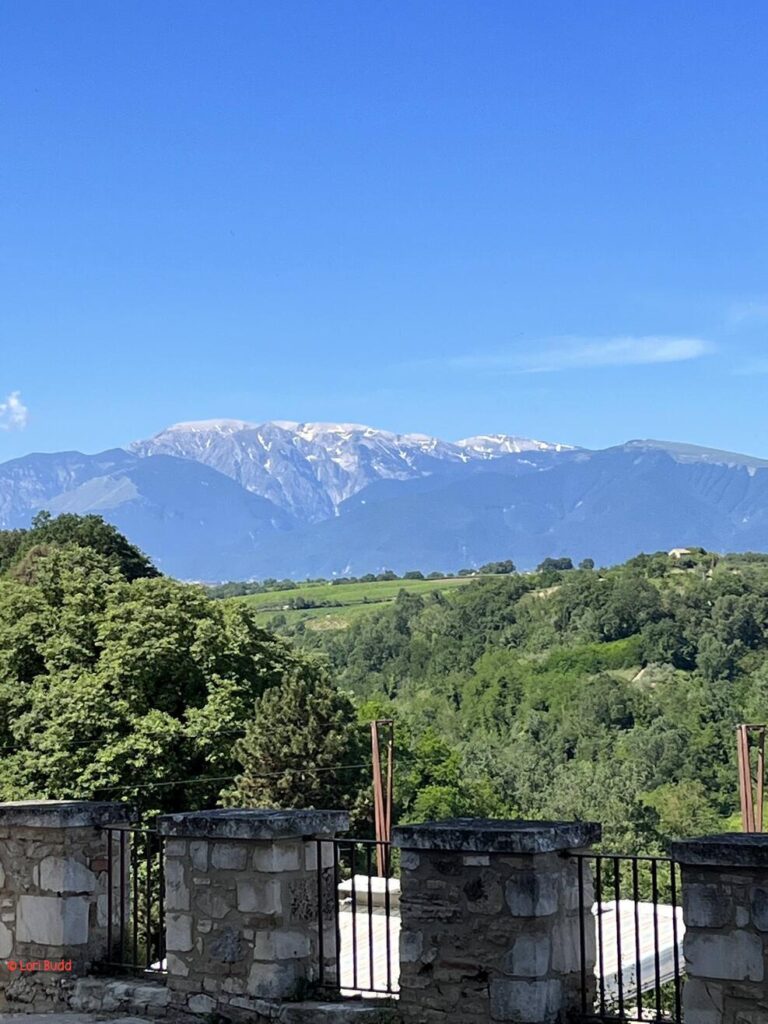
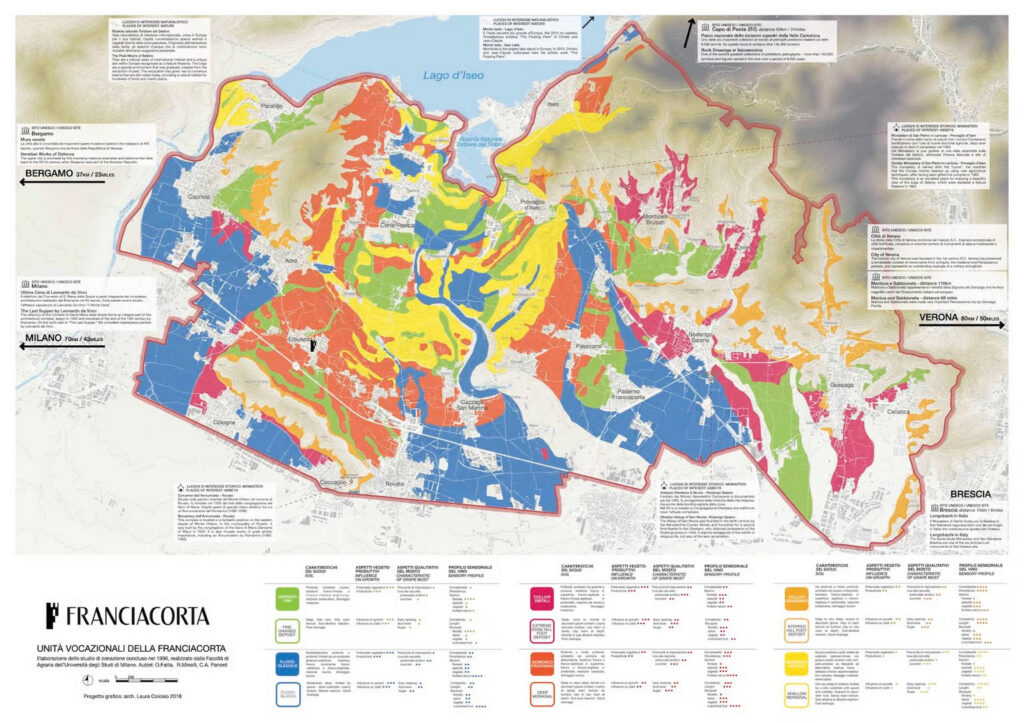
Located in a breathtaking morainic soil amphitheatre, the region spans about 50,000 acres, though only around 8,980 acres are currently planted to DOCG vineyards. Morainic soil (often referred to as glacial till or morainic deposit) is formed by the movement and ultimate retreat of glaciers. As massive rivers of ice advanced, they ground down rocks, crushed boulders, and picked up a vast, disorganized mix of debris, ranging from large stones down to fine silt and clay. These deposits were dumped or pushed along their paths and terminal points.
The landscape features rolling hills shaped by ancient glaciers, with a continental climate. Extensive soil research has identified a staggering 134 distinct soil types across the zone. Elevations reach up to 2,208 feet above sea level at the highest point, though most wineries sit comfortably around 1,100 feet. When examining Franciacorta from its lower valley floors up to its higher hillside slopes, temperature gradients and altitudinal differences dictate a very distinct rhythm for the harvest.
Across Franciacorta’s varying elevations, harvest timing and temperatures shift dramatically. The lower valley floors trap summer heat and face early spring frost risks, causing grapes to reach sugar ripeness first and triggering harvest as early as late July or early August. The mid-slopes around 1,100 feet enjoy optimal thermal regulation and Lake Iseo breezes, leading to a steady harvest by mid-August with great aromatic complexity. While the cooler, higher peaks up to 2,000+ feet experience sharp day-night temperature swings and slower ripening, pushing harvest to the very end of August or early September to preserve razor-sharp acidity.
The Strict Rules of Production
Franciacorta is firmly NOT Prosecco. While Prosecco relies on the second fermentation in the tank (Charmat method), Franciacorta strictly mandates the traditional method (Metodo Classico), which is the exact same secondary bottle-fermentation process used in Champagne.
Other rigid regulations define the region:
-
Manual Harvest: Hand-harvesting is strictly mandated.
-
Yield & Volume: Production is capped at a maximum of 20 million bottles for the entire region, keeping it a true connoisseur’s niche.
The Blend: The permitted grapes consist of 79% Chardonnay, 18.1% Pinot Nero (Pinot Noir), 2.6% Pinot Bianco, and 0.3% Erbamat. Pinot Bianco is capped at a maximum of 50% in a blend, while Erbamat is capped at 10%.
-
Pressure & Aging: There are strict controls on maximum atmospheric pressure. Standard non-vintage bottles require extended aging, while Vintage styles must age a minimum of 30 months on the lees before release, showcasing the unique character of a specific harvest year.
-
Satèn: A unique, silky style exclusive to Franciacorta. It must be made exclusively from Chardonnay or Pinot Bianco, aged a minimum of 24 months, kept to a gentle maximum of 5 atmospheres (giving it a softer, creamier mousse), and produced strictly in a Brut style.
-
Rosé: Must contain a minimum of 35% Pinot Nero, with Chardonnay capped at 65%, Pinot Bianco at 50%, and Erbamat at 10%, with a minimum 24-month age requirement from tirage.
Spotlight on the Wines We Tasted
Our tasting lineup at Catch showcased the sheer versatility, elegance, and dedication of the region’s producers. Here is the full breakdown of every bottle we explored:
-
Franciacorta Brut – Ferghettina: Known for capturing the true baseline soul of the estate, Ferghettina’s Brut delivers vibrant freshness, crisp green apple, white peach, and a brilliant structure with a fine, persistent perlage.
-
Franciacorta Brut P.R. Blanc – Monte Rossa: A gorgeous tribute to the winery’s founders (Paola Rovetta and Paolo Rabotti, a pioneer of the Franciacorta Consortium). This Blanc de Blancs balances complexity from reserve wines with bright, elegant finesse, offering notes of toasted brioche, citrus zest, and a creamy, mouth-filling texture.
-
Franciacorta Satèn – Clarabella: Representing the softer, silkier side of the region, Clarabella’s Satèn showcases organic farming with bright lemon, pear, and subtle almond notes, wrapped in that signature gentle, lower-pressure effervescence that melts on the palate.
-
Franciacorta Satèn Brut Millesimato (2022) – Monzio Compagnoni: When a wine is labeled as a Vintage (Millesimato), it means it is crafted from grapes harvested in a single exceptional year (in this case, 2022) and must undergo a minimum of 30 months of aging on the lees. This Satèn brings extra depth and structure, offering a generous, juicy palate of ripe orchard fruit balanced by a crisp acid backbone and nuanced hints of pastry cream.
-
Franciacorta Rosé Brut – Berlucchi ’61: A brilliant homage to the historic birth year of the region’s modern style. This Rosé highlights Pinot Nero’s structure with lovely wild strawberry, red currant, and citrus notes, backed by a refined, creamy mousse.
-
Franciacorta Rosé Brut – Castello Bonomi: Hailing from the slopes of Mount Orfano, this elegant expression balances red berry aromatics with herbal freshness, chalky minerality, and a crisp, savory finish.
-
Franciacorta Zero Dosage Vintage Collection (2021) – Ca’ del Bosco: Being “Zero Dosage” (or Pas Operé) means no sugar dosage is added after disgorgement, leaving the wine completely dry and unmasked. The 2021 Vintage Collection sings with razor-sharp precision, bright lemon oil, crisp green plum, and intense chalky minerality.
-
Franciacorta Riserva Zero Dosage “Bagnadore” (2016) – Barone Pizzini: The pinnacle of patience and terroir expression. A Riserva status requires even longer aging (at least 60 months on the lees!). The 2016 Bagnadore is rich, complex, and profound, offering layers of baked pear, roasted nuts, toasted brioche, and a laser-focused, bone-dry finish that lingers for minutes.
Whether you are looking to elevate a celebration or simply geek out over world-class traditional-method sparkling wine, Franciacorta deserves a front-row seat in your wine fridge. Have you explored the bubbles of this amazing region yet? Let me know your favorite producer in the comments below!
~Slàinte!
Ready to turn your passion into expertise? Whether you’re looking for foundational classes like Wine 101, Sparkling, and Rosé, or you’re ready for a deep dive into specific regions, we have a digital course or class for you! For those specifically interested in Spain, don’t miss our fun Exploring Spanish Wine: The Bingo Brains Edition or our professional-level Uncork Rioja Certification. Explore our full range of educational classes and find your next wine adventure: View All Wine Education Options.
I invite you to follow me on Instagram, Twitter, Facebook Threads and Youtube for all things wine. I’ll never tell you what to drink, but I’ll always share what’s in my glass. Please subscribe to my blog by entering your email address under “Subscribe to Blog by Email” in the right hand column.